
Invoking Mahatma Gandhi, two of the convicts on death row for the brutal torture and gang rape of a 23-year-old paramedical student on December 16 contested the trial court's sentence on Monday, telling the Delhi high court even the father of the nation was against capital punishment.

The Delhi high court on reserved its verdict on the appeals filed by four death row convicts in the December 16 gang rape case.

Jawaharlal Nehru University students Umar Khalid and Anirban Bhattacharya, facing sedition charge for allegedly raising anti-India slogans at the university campus last month, were on Friday granted interim bail for six months by a Delhi court on ground of parity with Kanhaiya Kumar.

Pachauri had proceeded on leave from TERI after sexual harassment charges were levelled against him by a woman employee.

The date of execution, first fixed for January 22, was postponed for 6 am on February 1 by a January 17 court order.

This is the fourth death warrant issued for the execution of the convicts in the matter.

The Enforcement Directorate in October last year had filed the complaint against Raju and 212 others, including 166 companies, before the XXI Additional Chief Metropolitan Magistrate Court cum Special Sessions Judge here for allegedly laundering funds under a 'corporate veil' to perpetrate the accounting scam that rocked the business world in 2009.

Additional Sessions Judge Raj Kumar Tripathi allowed the plea to modify the earlier order restricting his entry into the offices of TERI.

Judge Jagdale halted Dr Gupta's testimony several times because he felt it had neither order nor direction. Tightly controlling his irritation, his lips compressed, the judge explained as patiently as he could: "What he has done in this case should come (out in his testimony) in a lucid manner. You eat chapati and then rice. You cannot eat half a chapati and then have rice and then eat half a chapati..." "He is not a witness of facts. He is an expert witness. Either he is not prepared. Or you are not prepared."
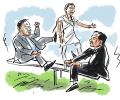
Dr Gupta handled Shivade's blows with quite some equanimity... So it was often only Shivade down in the mud pit, egging and enticing the doctor to join the fight, while Dr Gupta cautiously kept to the sidelines, barely stepping a toe into the mud.

The prosecution in the December 16 gang rape case on Saturday told a court in Mumbai that the brutal assault meted out to the victim and her male friend by the alleged rapists was with a motive to "eliminate" them so that neither was left alive to narrate the horrific ordeal.

The Delhi High Court on Wednesday allowed recall of 13 prosecution witnesses, including the victim in the Uber cab rape case, on the plea of the accused driver and said their cross examination will be carried out on a day-to-day basis.
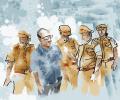
This is one of the many such cases that helped to create an acute fear psychosis among public sector bankers, reveals Tamal Bandyopadhyay in his fascinating new book Pandemonium: The Great Indian Banking Tragedy.

Happy with her latest move, Indrani departed from Courtroom 51 with a spring in her step. The woman who hopped up into the jail truck was a cheerful one.

The Friday morning encounter of all the four accused in the brutal rape-and-murder case of a 25-year-old woman veterinarian last month in Hyderabad triggered a nationwide debate on justice delivery, with one side supporting it as speedy justice and the other raising concerns over 'extra-judicial' measures. Here is a look at the legal status of some rape cases which shook the country.

Indrani is clearly in charge in her little corner. She is speaking rapidly to a not-very-tall, pot-bellied, balding man, whom she repeatedly, decisively, asks, "Have you understood?" The tone is that of a boss talking to an employee. The words "cheque" and "two lakhs" float by.

Indrani dressed in a short purple kurta and leggings, with a bandhini green-purple chunni, sindhoor glowing in her mang, was receiving a drubbing from her lawyers for the facts she had revealed before the court on Tuesday while arguing the rejoinder to her bail application. She was insisting: "But he asked me for a motive!"
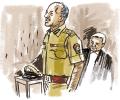
Clusters of policemen and television journalists alertly anticipated the arrival of Mumbai's joint commissioner of police, who, it was confirmed by most people I asked, does not visit court often. No one could remember when they had last heard of Deven Bharti appearing as a witness in a murder trial.

'I ask for bail in the name of justice.' 'Give me a chance to stay alive and see the trial till its end.'

'Stress, depression, PTSD and anxiety, especially relating to their domestic lives, are big issues for the men.' 'The men work in extremely difficult conditions, often with the fear of death looming large.'

'I have strong reasons to believe that Accused number 4 (A4) Pratim Mukerjea with the assistance of other persons, including Accused no 3 (A3) turned approver Shyamwar Pinturam Rai may have conspired and abducted my daughter Sheena in 2012 and made her untraceable and subsequently destroyed evidence.'

Peter's lawyer paints Indrani as a master manipulator, looking to waste the court's time and use the media to manipulate public perception about his client. 'She is "trying to exonerate herself," the lawyer argues, and accuses Indrani of "trying to lay a trap" for Peter "and attempting to malign his reputation"...'

There it lay, a photograph on the desk under a stapler, and later a stamp pad, forgotten, done with, like its subject, a Mumbai Metro One employee who vanished overnight.

Indrani's words were quick, her hand gestures quicker. She kept pointing to certain paragraphs in their consent terms.

He is, at the closing of 2018, a man quite different from the Peter Mukerjea who entered judicial custody three-and-a-half years ago. He is a man not yet convicted of a crime, but already suffering for it, like the hundreds that enter these courts every day and the thousands Peter shares jail space with in a central Mumbai prison.

'When the forensics have collapsed, approver is clearly proved to be a liar from the beginning to the end... Does the prosecution genuinely believe that we ought to remain in judicial custody despite showing that their own story is not being corroborated by evidence, for another 192 witnesses?'

Indrani and Peter Mukerjea seemed more at ease on Wednesday, maybe with the INX Media interrogation over temporarily, chatting cheerfully and easily amongst themselves, and with former husband Sanjeev Khanna, at the back of the courtroom, in the accused enclosure.

The question being silently telegraphed around the court room was: When did this happen? Wasn't this trial about Indrani murdering her daughter to prevent her from marrying Rahul Mukerjea, her husband Peter Mukerjea's son from his first marriage?

Indrani called her personal assistant Kajal Sharma from the UK, May 3, 2012, and told her she had to sign Sheena's resignation letter as if she was Sheena signing it. But she had to first practice the signature and send Indrani proof of her proficiency in signing Sheena's name before sending the letter off. Sharma said she was reluctant and told the court that she told Indrani as much, but Indrani demanded it of her.
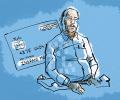
The prosecution's pursuit of this tiny detail was because they believed the charge from Google, on Indrani's account, was to restore Sheena's Gmail account, via the Google account recovery toolkit, since Indrani did not have the password.
'If I have to write a letter I will give it to the media. They will put it out.'
Universal basic income or social security? Economist Nitin Desai feels we need a blueprint for universal health care and pensions to help the vulnerable section.

'I kept photographs of everyone. Because I was working for them.' 'Madam, Saab...' Shyamvar Rai, the approver in the case, said in a tone that tried to suggest that that would be a routine practice for a driver.
 © 2026 Rediff.com - Advertise with us - Disclaimer - Privacy Policy - Sitemap - Feedback - About us - Terms of use - Grievances